Monday, January 26, 2015

The Bat Boy & His Violin

The Bat Boy & His Violin by Gavin Curtis
Illustrated by E.B. Lewis
Published by Simon & Shuster (1998)
Coretta Scott King Award

The Bat Boy & His Violin takes place around the 1920s and 1930s during the time of the Negro National Baseball Leagues. Reginald, a young boy is a gifted violinist. He spends all his free time practicing in the house. His father is manager of the Dukes, the worst Negro team in the league. They need a bat boy, so his father selects Reginald to come be the bat boy of the Dukes. Reginald is not thrilled with the decision because he doesn't think he will have enough time to practice his violin. He begins as a bat boy and struggles at his duties. His father tells him to take a break and play his violin. As he plays his violin, the Dukes start to play better and end up winning their game. The Dukes credit their victory to Reginald and his violin. When they play their final game of the season against the best team of the league, they narrowly lose and Reginald feels bad he couldn't help them win. His father reassures him that his violin playing was a huge part of their success. He finally gets to perform in from of the team, family, and friends at his home; it was a recital to remember for Reginald.

While the story is fiction, it takes place in the historical framework of segregation. It would fit well into a history unit about segregation and baseball at that time in American history. It would give students a good view into the life of some people during that time. It also has a large music theme. Students who play the violin could easily understand Reginald's position. It could be a supporting book to a unit on Bud, Not Buddy also due to its music theme and historical placement.

The detailed water-color illustrations catch your eye. E.B. Lewis researched the time period in order to make his paintings most realistic. The language is a bit difficult for young readers.

The Coretta Scott King Award alone shows that this book represents the ideals of peace, non-violent social change, and brotherhood. This is a positive book to connect to our nation's past.

Curtis, G., & Lewis, E. B. (1998). The bat boy & his violin. New York: Simon & Schuster Books for Young Readers.

The Important Book

The Important Book by Margaret Wise Brown
Pictures by Leonard Weisgard
Published by Harper and Row (1949)

I first heard about The Important Book last semester thanks to one of my Education professors. She shared some of the book with the class. I knew I just had to read the book because it feels like a classic piece of children's literature.

The story is written in a repetitive, almost poem-like, nature. It starts each page with the line, "The important thing about ___(noun)_____ is that_______. It is followed by a couple sentences about various details about the noun, and ends with the same sentence it began with to reiterate its main point. The book talks about several ordinary items such as spoons, shoes, the sky, snow, and apples. I included a picture of the last page of the book which is my absolute favorite.

This book has many applications in the classroom. It is a great book to use at the beginning of the year for students to talk about themselves and what makes them important and different. One of my classmates read this book to a class of 4th graders and had them choose something they wanted to write about. She compiled their pages into a classroom book of important things. I love that idea! This book challenges students to look at simple items such as a daisy or the wind and really think about what makes that thing different from the rest of the world. The Important Book could be used in a variety of grade levels also.

The illustrations in the book are fairly life-like. Leonard Weisgard uses both color and black and white to give the reader various perspectives.

I would highly recommend that The Important Book has a place on the shelf in every teacher's classroom!

Brown, Margaret Wise, and Leonard Weisgard. The Important Book. New York: Harper, 1949. Print.

The Lemonade Club

The Lemonade Club by Patricia Polacco
Published by Philomel Books (2007)

The Lemonade Club is not your ordinary children's book; it tackles the tough topic of cancer. The story follows two 5th grade girls who are best friends, Traci and Marilyn. They love their teacher, Miss Welchelman and her inspirational story of making lemons into lemonade. Marilyn eventually becomes ill with Leukemia and undergoes chemotherapy. Traci remains by her side, along with Miss Welcheman. When Marilyn returns to school, embarrassed by her lack of hair, she finds out that the rest of the class shaves their heads in camaraderie, even Miss Welchelman. As everyone's hair starts to grow again, Traci and Marilyn notice that Miss Welchelman's hair does not grow back. She tells the girls that she has breast cancer. The girls rally around her and remind her of the dreams and hope that she gave to the girls as their teacher. At the end of the story, 5 years later and cancer-free, Miss Welchelman gets married with Traci and Marilyn at her side. It is truly a story of hope and courage. It is based off of a true story as Traci is Patricia Polacco's daughter.

I would highly recommend this book to any classroom that has a student with cancer. It is appropriate for an older audience. Even as an adult, I found the storyline tough to handle. It's probably because everyone knows someone who has dealt with cancer. This makes the story hit home to many and really touch at one's heart. It is an excellent book to teach students how to show empathy and compassion.

The illustrations are classic Patricia Polacco. The characters appear quite realistic with the pencil drawings. The characters' faces are filled with emotions and feelings, giving you a better look at how the characters are feeling. This piece of literature gives a whole new meaning to the phrase, "When life gives you lemons, make lemonade". Patricia Polacco has put a "sweet" spin on a "sour" subject!

Polacco, P. (2007). The Lemonade Club. New York: Philomel Books.

Are the Dinosaurs Dead, Dad?

Are the Dinosaurs Dead, Dad? by Julie Middleton (England)
Illustrated by Russell Ayto (England)
Published by Peachtree Publishers 2012 (Great Britain) 2013 (United States)

Are the Dinosaurs Dead, Dad? is a fun children's picture book that shows that parents should listen to their kids every once in awhile. Dave and his dad go to a museum to see The Amazing Dinosaur Exhibition. As they travel through the exhibition, Dave falls a bit behind his dad and sees the true nature of the dinosaurs. The dinosaurs appear dead as his dad pass by, but right after Dave passes by them, they come to life and try to play with Dave. He continues to ask if it is possible for the dinosaurs to do these things, and every time his dad dismisses his thoughts telling him that it is just his imagination. At the end of the story, Dave proves to his father that he is right about the dinosaurs being alive as a dinosaur roars and knock them off their feet.

The illustrations are more abstract and dramatic, but they are very colorful. The big book would be a great read aloud because of the fun illustrations. The repeated language would make this a good book for younger readers. However, it does include some difficult vocabulary that would make it a better story for a read aloud.

This story would fit in well with a lesson on listening to others and what they are saying. It could also be utilized for a unit on punctuation and quotation marks because those are prevalent in the story. If you were doing a lesson on dinosaurs and science, it would be a great introduction piece.

I would recommend this book to Kindergarten through Second grade classrooms. Students would enjoy the storyline because the child is right as opposed to the parent, and the illustrations are different.

Middleton, J., & Ayto, R. (2013). Are the dinosaurs dead, Dad?.

Rain Makes Applesauce

Rain Makes Applesauce by Julian Scheer
Pictures by Marvin Bileck
Caldecott Honor Book (1965)
Published by Holiday House, New York 1964

Rain Makes Applesauce is a silly piece of children's literature that is sure to make students laugh and wonder. It almost reads like a poem with each page starting with a silly and made-up sentence followed by the phrase, "Rain makes applesauce". It is a treasure hunt on each page to find the saying "Oh you're just talking silly talk". It is a fantasy piece with excellent illustrations.

Marvin Bileck puts great detail into his fairy-like illustrations. They are sure to capture students' attention. The soft hues of color enhance the details through each page.

When I was a sophomore in college, I had a professor who read this book to us on a stormy afternoon. She told us how she would read this to her young students when it was thunder storming in order to calm them done and make them less afraid. I thought it was a great idea! Rain Makes Applesauce is the perfect read aloud because of its repetition and imaginative illustrations. Students can start choral reading with this book. Another possibility would be creating a classroom book based on the book. Each student could create a phrase with a silly saying and add their own illustration. It would fit well into a Poetry Unit or Creative Writing Unit. As a lower elementary school teacher, I would say this book is a must read for story time!

Scheer, J., Bileck, M., & Holiday House (Firm). (1964). Rain makes applesauce. New York: Holiday House.

Tuesday, January 20, 2015

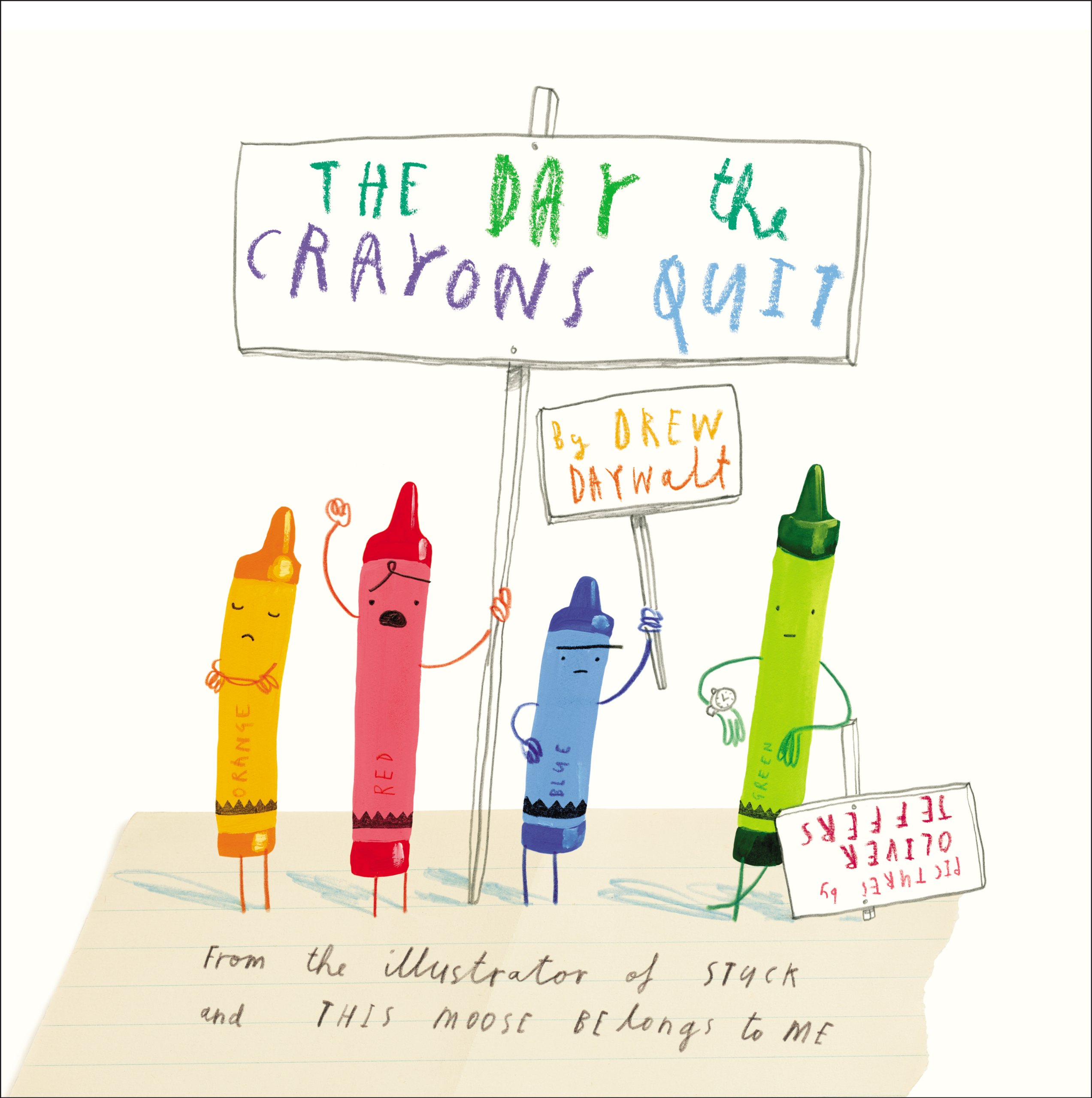
The Day the Crayons Quit

The Day the Crayons Quit by Drew Daywalt
Pictures by Oliver Jeffers
Philomel Books 2013

The Day the Crayons Quit follows the story of a young boy named Duncan who goes to use his crayons only to find notes written by each of his crayons explaining that they have quit. Each crayon has a different explanation. Some are overused and others are never used. Duncan must figure out how to make his crayons happy again. 

Oliver Jeffers does an excellent job by providing realistic drawings that look like they came right from a child. Each page contains a note that is written in the color of crayon that is talking, along with a picture drawn by that crayon. The illustrations are sure to get children's attention with their vibrant colors! 


The book is a great read aloud for young children. The language might be difficult for emergent readers, but older Elementary students would have fun reading this book out loud to a partner. 


The Day the Crayons Quit has a lot of potential for classroom use. I used this book to teach a writing lesson to First Graders. After reading the story out loud, the students wrote apology notes to one of their crayons align with a colorful picture to make their crayons happy. The first graders loved it!


Daywalt, D., & Jeffers, O. (2013). The day the crayons quit.