Showing posts with label traditional literature. Show all posts

Tuesday, April 21, 2015

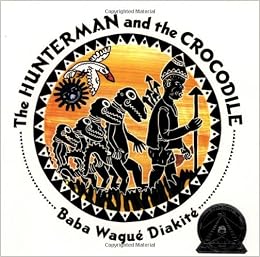
The Hunterman and the Crocodile

The Hunterman and the Crocodile: A West African Folktale
retold and illustrated by Baba Wagué Diakité
published by Scholastic Press 1997

Coretta Scott King Award

This folktale tells the story of three crocodiles who leave their home in the river and eventually become tired and famished. They meet a crocodile who they convince to take them back home to the river. They promise they won't eat him up as most crocodiles would do. However, when they return to the river, they question their choice and argue with right over wrong with the hunterman. Various animals weigh in on their opinions of the situation. The animals say that the crocodiles should eat the hunterman because of various things man does to the animals. At the end, a rabbit tells the man to bring the crocodiles back home to his family instead. Th man learns a valuable lesson, as his wife has fallen ill and needs the tears of a crocodile to live. The lesson to be learned is that man and nature must live in harmony.

I very much enjoyed this piece of literature. It would be a great mentor text for teaching write and wrong or respect for nature. The abstract illustrations really keep your intention. There is a mix of color and black and white along with watercolor backgrounds. It is a great book to show students the West African culture.

Diakité, B. W. (1997). The hunterman and the crocodile: A West African folktale. New York: Scholastic.

Friday, March 6, 2015

Stone Soup

Stone Soup by Marcia Brown
Published by Antheneum Books for Young Readers 1947

Caldecott Honor Book

I heard about this book from my professor last semester. She told us about how she would make stone soup with her students after she read the book.

The story of Stone Soup is an old tale of three hungry soldiers who are looking for food and somewhere to sleep. The villagers don't have much food and don't want to share with the soldiers. The soldiers trick the villagers into making soup by beginning the soup with three smooth stones. They end up with a delicious soup for all the village after their sneaky requests.


Young students would love this story, and I am sure they would love making stone soup! The book uses only brown and orange illustrations with detailed character faces.


There are lots of fun activities for using Stone Soup in the classroom! Check out this alternate version of the story...

Brown, M., & Charles Scribner's Sons. (1947). Stone soup: An old tale. New York: Charles Scribner's Sons.

The Egyptian Cinderella

The Egyptian Cinderella by Shirley Climo
Illustrated by Ruth Heller
Published by Thomas Y. Crowell 1989

The Egyptian Cinderella puts a twist on the classic Cinderella fairytale most of us know. While the plot remains the same, characters from the historical past of Egypt are used instead. The book has many classroom applications whether it be through social studies and ancient Egypt, or comparing and contrasting in literature and fairytales.

The illustrations are vibrant and detailed, making you feel like you are in ancient Egypt. I would highly recommend this book for an upper elementary classroom. It is a sophisticated piece of children's literature that will appeal to older students.

Climo, S., & Heller, R. (1989). The Egyptian Cinderella. New York: Crowell.

Tuesday, March 3, 2015

Little Red Riding Hood

Little Red Riding Hood 
retold and illustrated by Trina Schart Hyman (originally by Grimms)
Published by Holiday House 1983
Caldecott Honor Book

Growing up, Little Red Riding Hood was one of my favorite and most memorable fairytales. As Little Red Riding Hood brings her beloved grandmother some wine and bread to make her feel better, she encounters a wolf who leads her astray to pick wildflowers while he sneaks into the grandmother's house and eats her right up! When little red riding hood arrives to her grandmother's, she discovers the wolf and is also eaten right up. A hunter hears the wolf snoring after his meal. He realizes the wolf has eaten the grandmother and little red riding hood so he cuts open the wolf's stomach and frees them. He takes the wolf with him, and grandmother and little red riding hood finally enjoy the bread, wine, and tea.

This particular version has illustrations by one of my favorite illustrators. She also illustrated A Child's Calendar, another one of my favorites! Her illustrations are well detailed; she uses soft black lines to make the colors pop off the pages. Each page is filled with hidden details that make you wan
t to search the page to discover what is there.

Hyman, T. S., Grimm, J., & Grimm, W. (1983). Little Red Riding Hood. New York: Holiday House.

The Ugly Duckling

The Ugly Duckling by Hans Christian Anderson
Illustrated by Adrienne Adams
Published by Charles Scribner's Sons 1965

The Ugly Duckling is a classic piece of literature by the notable Hans Christian Anderson. The tale tells the story of duckling whose outward appearance is quite different from the rest of his brothers and sisters. He is constantly teased by others for his ugly appearance and struggles to fit in anywhere. Eventually he sees his reflection in the water and discovers he has turned into a beautiful swan who is loved by all. He finally fits in and feels happiness to belong.

This story would be a great text for all ages; it provides an important lesson on how we treat others based on assumptions and outward appearance. I think it is an important story for all children to hear, especially with the incidences of bullying in schools today.

This version particularly, has beautiful and detailed images with soft watercolor pictures.

Andersen, H. C., Adams, A., & Keigwin, R. P. (1965). The ugly duckling. New York: Scribner.