Thursday, February 19, 2015

Bud, Not Buddy

Bud, Not Buddy by Christopher Paul Curtis
Published by Delacorte Press 1999

Newberry Honor Book
Coretta Scott King Honor Book
ALA Notable Book
ALA Best Book for Young People
A Horn Book Fanfare
A Bulletin Blue Ribbon Book
A New York Times Book Review Best Book
A Publishers Weekly Best Book

With all these awards, you can see Bud, Not Buddy is a must read book. It was a book I could easily relate to because I grew up and still live in Michigan. It tells the story of ten year old Bud, a motherless boy, during the Great Depression. He runs away in search of his father with a suitcase of important things, and a flyer that he believes will lead him to his father. The book follows Bud's adventure to find his father.

Bud, Not Buddy would be a great book to read when learning about the Great Depression and all that is associated with that era such as jazz music.

This blog has some great project ideas related to the book!

Curtis, C. P. (1999). Bud, not Buddy. New York: Delacorte Press.

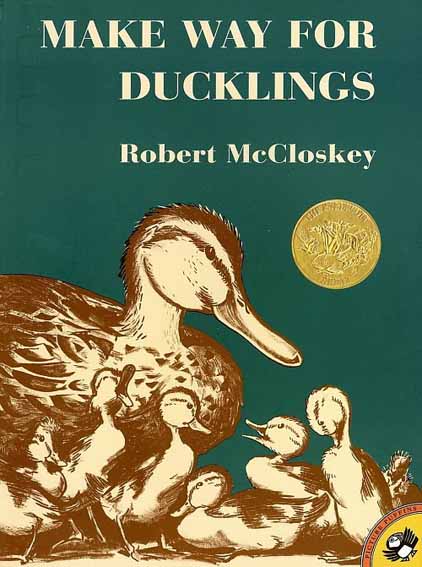
Make Way for Ducklings

Make Way for Ducklings by Robert McCloskey
Published by The Viking Press 1941

 The Caldecott Medal 1941

Make Way For Ducklings is a classic children's book that has been around for generations. It tells the story of a family of ducklings, the Mallards, who travel through the parks of a big city to eventually settle on a small island in the Boston Public Garden.

What makes this book so special is the illustrations. The brown pencil drawings and attention to detail can easily be noticed. The drawings appear textured with the use of line and pattern.

This story would be a great read aloud for young students because it is definitely a page turner. I still recall one of my professors reading this book to my class and showing us a video of it. I knew it was a book that I want part of my children's literature collection.


McCloskey, R., McCloskey, R., Viking Press., Duenewald Printing Corporation., & Affiliated Lithographers. (1941). Make way for ducklings. New York: Viking Press.

Wednesday, February 18, 2015

The Hundred Dresses

The Hundred Dresses By Eleanor Estes
Illustrated by Louis Slobodkin
Published by Harcourt Brace & Company 1944

Newberry Honor Book

The Hundred Dresses is a powerful story for young students to hear on compassion, kindness, and doing what is morally right. Students can be cruel to one another in school. Wanda, a shy student in the class is the victim of teasing from other girls in the class due to her hand-me-down clothes. One of the young girls, Maddie, begins to feel bad for her actions, but can't seem to bring herself to say anything. Eventually Wanda does not return to school, which worries Maddie. However, the impending drawing contest takes over the focus. When the contest comes to a close, Wanda returns to school to show off her drawings of hundred different dresses all over the classroom. Wanda wins the contest but does not return to school as her family moves away to an area where she won't be made fun of. Maddie and her friend Peggy try to make it up to Wanda, but realize that you cannot always make amends.

This book is excellent for students in grades 3-5. It is part chapter book, part picture book. It is an easily relatable story for students that teaches an important lesson for all students to hear. The Hundred Dresses exemplifies the Golden Rule. The whimsical illustrations with blended lines and soft colors catches the readers eye and adds imagery that enhances the story.

Scholastic.com provides a lesson plan that may be helpful if bullying is an issue in your class, or you just love the book like I do!

Estes, E., & Slobodkin, L. (1944). The hundred dresses. New York: Harcourt, Brace and Co.

Tuesday, February 17, 2015

A Child's Calendar

A Child's Calendar
Poems by John Updike
Illustrations by Trina Schart Hyman
Published by A Holiday House Book 1999

Caldecott Honor Book 2000

A Child's Calendar brings me back to my childhood. When I discovered it in the library recently, memories rushed over me of the times I would sit in bed with this book of poetry and try to read its beautiful pages. As I perused through its pages once again, I can see why I was so attached to it. A Child's Calendar follows the activities of children as they pass through the twelve months of the year.  Each poem contains four to six stanzas with rhyming lines. The poetry is wonderful, but what really catches the readers eye is the detailed watercolor illustrations. You can feel each month through the colors used in the realistic pictures. The same children's faces are used throughout, which makes it like a treasure hunt to see if you can spot each one. I believe this book should be a staple in each home!

This would be an excellent mentor text for poetry. I can see myself easily using A Child's Calendar to create a classroom calendar with poetry from each student. It would be a great way to incorporate science and seasons with poetry.


Updike, J., & Hyman, T. S. (1999). A child's calendar. New York: Holiday House.


Flora and Ulysses: The Illuminated Adventures

Flora and Ulysses: The Illuminated Adventures
By Kate DiCamillo
Illustrated by K.G. Campbell
Published by Candlewick Press 2013

Newberry Medal Winner 2014

Kate DiCamillo is one of my all time favorite children's authors. With all her awards, many would find it hard to disagree that she is one of the best. If you aren't familiar with Kate check out her website to learn more!

If you want a good laugh for both you and your students, Flora and Ulysses is the book for you.  Flora and Ulysses tell the wild adventure of a squirrel with magical powers and his cynical friend Flora Belle Buckman. Flora befriends the poor squirrel who is vacuumed up by her neighbor, Mrs. Tickham’s powerful vacuum. She names him Ulysses, after the multi-terrain vacuum that sucked him up. Flora’s mother, an avid writer, is not pleased with having a squirrel in the house, but Flora claims that Ulysses is a super hero and her friend. Flora’s mother does not believe and plans to kill the squirrel. Mrs. Tickman believes Flora and tries to help her. Mrs. Tickman’s great nephew, a young man Flora’s age, joins the fun and develops feelings for Flora. Flora initially despises him, but soon grows to appreciate his presence. Flora’s father supports his daughter and her superhero-squirrel friend. The three of them go on a wild adventure that includes a diner disaster and a run in with a special cat and so –called “Dr.” Meescham. Throughout the novel, Flora joins forces with Ulysses to conquer evil. The two develop a strong friendship and defy odds to remain together even after Flora’s mother kidnaps Ulysses and tries to kill him with a shovel. After all the commotion and evil-fighting, all come to see Ulysses as a superhero who manages to bring all of Flora’s loved ones into her life again. He also manages to turn her from a cynic to one who sees love in the world.


The novel also contains black and white pictures, and reads like a graphic novel in some places. The illustrations greatly enhance the writing and make the story come alive in your mind. It would also be beneficial for visual learners. This novel would be a great read aloud for a young classroom, or could be a great classroom book for a unit study. I could easily read this book over and over and I would still laugh each time. 

For more resources check out the Flora and Ulysses Website here!

DiCamillo, K., & Campbell, K. G. (2013). Flora & Ulysses: The illuminated adventures. 

Friday, February 6, 2015

Alexander and the Terrible, Horrible, No Good, Very Bad Day

Alexander and the Terrible, Horrible, No Good, Very Bad Day by Judith Viorst
Illustrated by Ray Cruz
Published by Anthem Books for Young Readers (1972)

"It has been a terrible, horrible, no good, very bad day. My mom says some days are like that."

These are words that I have heard from my own mother on many occasions. We have all had those days where nothing goes our way. Alexander has a terrible, horrible, no good, very bad day, from beginning to end. Nothing seems to go his way. This makes him want to move to Australia. Alexander realizes that some days are just going to be this way, even in Australia.

This longer picture book, approximately 25 pages, contains detailed pencil drawings. The black and white drawings are not typical of most colorful picture books. Great attention has been paid to each illustration. I wish the book had a sequel about a very good day for Alexander. The book has been recently adapted to a movie. Check out the trailer!

After reading in your classroom, the book could be used as inspiration for students dealing with emotions from a very bad day. If students are having a bad day or something is upsetting them, they can take a flag of Australia and move to a separate space in the room to calm down and reflect. This is a great classroom management technique. Students and teachers can learn a lot from Alexander!
Viorst, J., & Cruz, R. (1972). Alexander and the terrible, horrible, no good, very bad day. New York: Atheneum.