Showing posts with label poetry. Show all posts

Tuesday, April 21, 2015

Confetti: Poems for Children

Confetti: Poems for Children
(Confeti: Poemas para NiƱos)
By Pat Mora
Illustrated by Enrique Sanchez
Published by Lee & Low Books 1996

Confetti is a wonderful bilingual book for young children that gives them a taste of the southwest and its beautiful nature. The narrative, free verse poems are great for young readers. There is  mix of rhyming and free verse to show students that not all poems rhyme. It combines spanish and english in a great way, showing the experience of a young Mexican-American girl. They will especially connect with the young female perspective.  This vibrant illustrations of this book of poetry will be sure to keep students' attention. This would be an excellent book to have in your classroom library as many students have a hispanic background or are learning spanish in school. Poetry is a great way to share the culture of Mexican-Americans and the southwest.

Find out more about Pat Mora!

Mora, P., & Sanchez, E. O. (1996). Confetti: Poems for children. New York: Lee & Low Books.

Poetry for Young People- Lewis Carroll

Poetry for Young People- Lewis Carroll
Edited by Edward Mendelson
Illustrated by Eric Copeland
Published by Scholastic Inc. 2001

My cooperating teacher shared this book with me, and it is quite the treasure. I am teaching a lesson on the poem "Jaberwocky" by Lewis Carroll to my fourth graders. The nonsense poem comes from his famous Alice and Wonderland story. I am going to have the students listen to the poem and illustrate what they believe a Jaberwocky is. I think it will be a really cool lesson!

This book contains many of Lewis Carroll's poems with soft, watercolor illustrations. Many of the poems contain a short introduction with background information. For those students who love Lewis Carroll, this book is for them. It is directed towards older readers, probably grades four and up. His work could also provide a great text in the classroom for various activities such as poetry, powerful language, word choice, and fantasy. I will definitely be looking into more books like this one because I think a book like this can really get students to be interested in poetry.

Carroll, L., Mendelson, E., & Copeland, E. (2000). Lewis Carroll. New York: Sterling Pub. Co.

If Not for the Cat

If Not for the Cat
Haiku by Jack Prelutsky
Paintings by Ted Rand
Published by Scholastic Inc. 2004

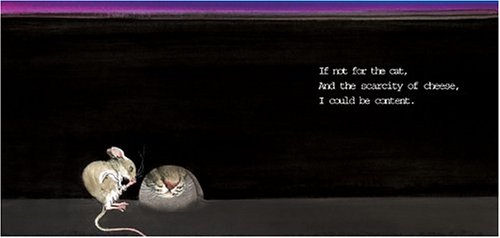
If Not for the Cat is a great piece of poetry by Jack Prelutsky. Each page contains a different animal haiku. One of my personal favorites is this one:

Wingless we went in,
But we emerged as fliers-
And oh, such colors!

The images of animals are quite realistic and colorful throughout. This piece of poetry would be a great model for students learning about haikus. It would be awesome to create your own classroom book of animal haikus like this one. It could connect well to a science lesson on animals. You can never go wrong with Jack Prelutsky!

Prelutsky, J., & Rand, T. (2004). If not for the cat: Haiku. New York: Greenwillow Books.

Monday, March 2, 2015

A Wreath for Emmett Till

A Wreath for Emmett Till by Marilyn Nelson
Illustrated by Philippe Lardy
Published by Houghton Mifflin Company 2005

Coretta Scott King Honor Award
Michael L. Printz Award for Excellence in Young Adult Literature from the American Library Association

This book takes on an important issue of the civil rights movement: Emmett Till and his lynching. I feel the author's explanation of her purpose for wiring this story into poetry is best explained through her own words. Regarding the writing of the poem she says, "I was nine years old when Emmett Till was lynched in 1955. His name and history have been a part of most of my life. When I decided to write a poem about lynching for young people, I knew I would write about Emmett Till. he was lynched when he was the age of the young people who might read my poem. After revisiting what I knew about lynching, reading more about it, and growing increasingly depressed, I also knew that I would write this poem as a heroic crown of sonnets. A sonnet is a fourteen- line rhyming poem in iambic pentameter. The rhyme scheme I chose to use in these sonnets is called Italian, or Petrarchan. A crown of sonnets is a sequence of interlinked sonnets in which the last line of one becomes the first line, sometimes slightly altered, of the next. A heroic crown of sonnets is a sequence of fifteen interlinked sonnets, in which the last one is made up of the first lines of the preceding poem".

This novel was difficult to read, but it gave a new perspective on an important issue of America's history. It would be a great mentor text or contributing text for a study on the civil rights for older students. The novel contains abstract imagery with colors that set the mood for each of the sonnets. At the end, an acrostic poem is formed, showing another type of poetry that students can utilize. It also provides notes on each of the sonnets she references in her poetry along with a brief story of Emmett Till.

I found a great online resource for using this piece of poetry in the classroom!

This piece of literature shows that poetry has the power to express even the darkest of things in a new light.

Nelson, M., & Lardy, P. (2005). A wreath for Emmett Till. Boston: Houghton Mifflin.

Tuesday, February 17, 2015

A Child's Calendar

A Child's Calendar
Poems by John Updike
Illustrations by Trina Schart Hyman
Published by A Holiday House Book 1999

Caldecott Honor Book 2000

A Child's Calendar brings me back to my childhood. When I discovered it in the library recently, memories rushed over me of the times I would sit in bed with this book of poetry and try to read its beautiful pages. As I perused through its pages once again, I can see why I was so attached to it. A Child's Calendar follows the activities of children as they pass through the twelve months of the year.  Each poem contains four to six stanzas with rhyming lines. The poetry is wonderful, but what really catches the readers eye is the detailed watercolor illustrations. You can feel each month through the colors used in the realistic pictures. The same children's faces are used throughout, which makes it like a treasure hunt to see if you can spot each one. I believe this book should be a staple in each home!

This would be an excellent mentor text for poetry. I can see myself easily using A Child's Calendar to create a classroom calendar with poetry from each student. It would be a great way to incorporate science and seasons with poetry.


Updike, J., & Hyman, T. S. (1999). A child's calendar. New York: Holiday House.