Tuesday, March 17, 2015

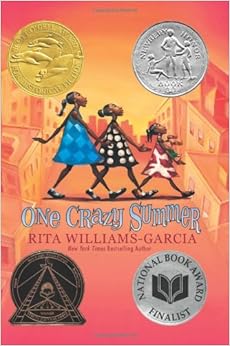
One Crazy Summer

One Crazy Summer
By Rita Williams-Garcia
Published by Amistad (2010)

Winner of the Coretta Scott King Award in 2011
Newberry Honor Book in 2011
(plus many many more!)

Our class read this award winning novel and created lesson plans based on the story. The moving story takes place during the civil rights movement in Oakland, California. Three young girls, Delphine, Vonetta, and Fern fly out to visit their long lost mother. With few memories of her, it leads to an adventurous and crazy summer involving the Black Panthers. I can see why this book won so many awards. Rita Williams-Garcia keeps you engaged and laughing even during heavy topics.

It is a great way for young readers to see the civil rights movement from a child's perspective. Not all students may be ready for the hot topic, but it is important for all students to learn about. The book would be a great class read to connect to social studies. Thanks to my wonderful classmates I have some great lesson ideas too!

Williams-Garcia, R. (2010). One crazy summer. New York: Amistad.

Friday, March 6, 2015

Stone Soup

Stone Soup by Marcia Brown
Published by Antheneum Books for Young Readers 1947

Caldecott Honor Book

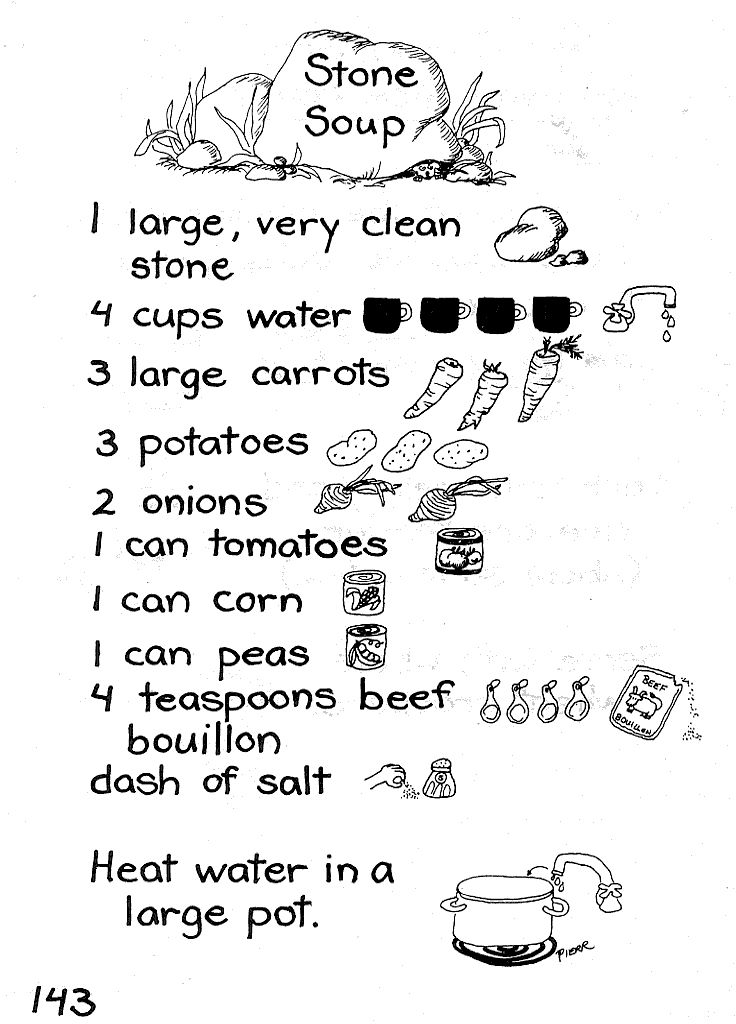
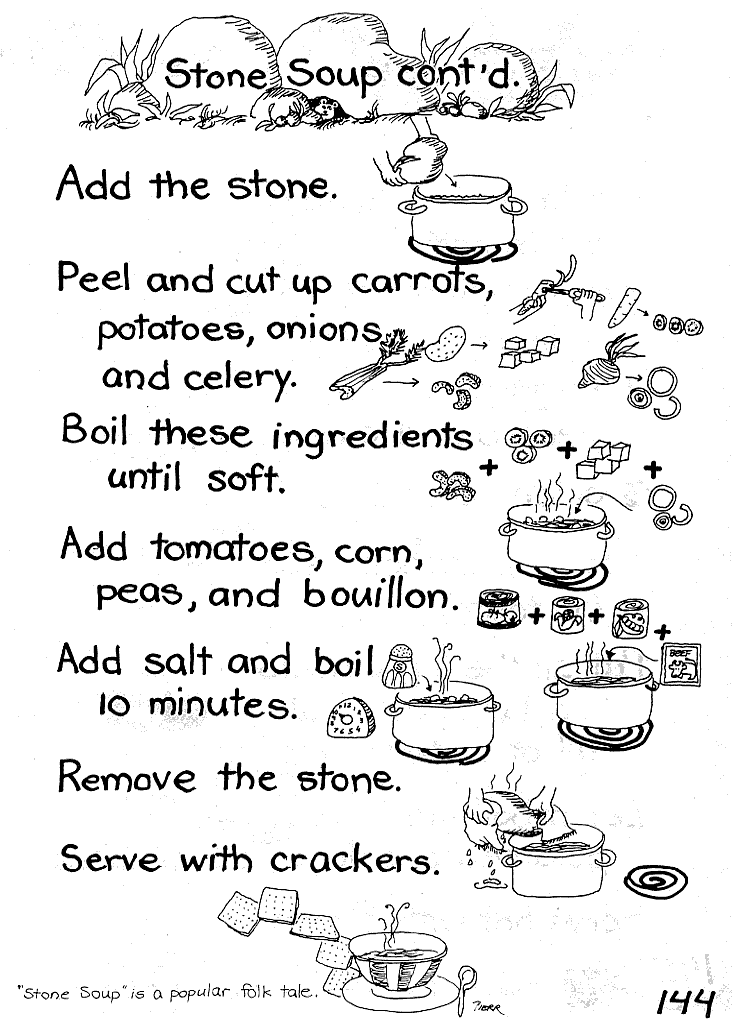
I heard about this book from my professor last semester. She told us about how she would make stone soup with her students after she read the book.

The story of Stone Soup is an old tale of three hungry soldiers who are looking for food and somewhere to sleep. The villagers don't have much food and don't want to share with the soldiers. The soldiers trick the villagers into making soup by beginning the soup with three smooth stones. They end up with a delicious soup for all the village after their sneaky requests.


Young students would love this story, and I am sure they would love making stone soup! The book uses only brown and orange illustrations with detailed character faces.


There are lots of fun activities for using Stone Soup in the classroom! Check out this alternate version of the story...

Brown, M., & Charles Scribner's Sons. (1947). Stone soup: An old tale. New York: Charles Scribner's Sons.

The Egyptian Cinderella

The Egyptian Cinderella by Shirley Climo
Illustrated by Ruth Heller
Published by Thomas Y. Crowell 1989

The Egyptian Cinderella puts a twist on the classic Cinderella fairytale most of us know. While the plot remains the same, characters from the historical past of Egypt are used instead. The book has many classroom applications whether it be through social studies and ancient Egypt, or comparing and contrasting in literature and fairytales.

The illustrations are vibrant and detailed, making you feel like you are in ancient Egypt. I would highly recommend this book for an upper elementary classroom. It is a sophisticated piece of children's literature that will appeal to older students.

Climo, S., & Heller, R. (1989). The Egyptian Cinderella. New York: Crowell.

Tuesday, March 3, 2015

The Miraculous Journey of Edward Tulane

The Miraculous Journey of Edward Tulane by Kate DiCamillo
Illustrated by Bagram Ibatoulline
Published by Candlewick Press 2006

short chapter book for ages 7-10 (200 pages)

The Miraculous Journey of Edward Tulane follows the adventure of a prideful china rabbit named Edward who lives with a young girl named Abilene on Egypt street. He is always dressed to the nines and treated as one of the family. Eventually, on Abilene’s family trip to England, Edward flies overboard only to be picked up by a fisherman named Lawrence. Lawrence’s wife Nellie befriends Edward, and takes care of him. Lolly, Lawrence and Nellie’s daughter, throws him into the garbage. Bull, a rail rider, and his dog Lucy find Edward and carry him along with them as they travel. Later, he is thrown off of the train and found by a young boy named Bryce. Bryce brings Edward to comfort his young sister, Sarah Ruth, who is ill. After Sarah Ruth passes away, Bryce runs away and brings Edward with him. Edward is involved in an accident that breaks him to pieces. Bryce cannot afford to pay the doll maker to fix him so the doll maker keeps Edward and mends him back together. He remains on the shelf for several years before Abilene’s daughter picks him out at the store. The story comes full-circle on one very miraculous journey.


      I would highly recommend this novel for either a read aloud or literature circle. Throughout the novel, detailed pencil illustrations enhance the story and set the context for the chapter. Check out the website for more information!


DiCamillo, K., & Ibatoulline, B. (2006). The miraculous journey of Edward Tulane. Cambridge, Mass: Candlewick Press.

Little Red Riding Hood

Little Red Riding Hood 
retold and illustrated by Trina Schart Hyman (originally by Grimms)
Published by Holiday House 1983
Caldecott Honor Book

Growing up, Little Red Riding Hood was one of my favorite and most memorable fairytales. As Little Red Riding Hood brings her beloved grandmother some wine and bread to make her feel better, she encounters a wolf who leads her astray to pick wildflowers while he sneaks into the grandmother's house and eats her right up! When little red riding hood arrives to her grandmother's, she discovers the wolf and is also eaten right up. A hunter hears the wolf snoring after his meal. He realizes the wolf has eaten the grandmother and little red riding hood so he cuts open the wolf's stomach and frees them. He takes the wolf with him, and grandmother and little red riding hood finally enjoy the bread, wine, and tea.

This particular version has illustrations by one of my favorite illustrators. She also illustrated A Child's Calendar, another one of my favorites! Her illustrations are well detailed; she uses soft black lines to make the colors pop off the pages. Each page is filled with hidden details that make you wan
t to search the page to discover what is there.

Hyman, T. S., Grimm, J., & Grimm, W. (1983). Little Red Riding Hood. New York: Holiday House.

The Ugly Duckling

The Ugly Duckling by Hans Christian Anderson
Illustrated by Adrienne Adams
Published by Charles Scribner's Sons 1965

The Ugly Duckling is a classic piece of literature by the notable Hans Christian Anderson. The tale tells the story of duckling whose outward appearance is quite different from the rest of his brothers and sisters. He is constantly teased by others for his ugly appearance and struggles to fit in anywhere. Eventually he sees his reflection in the water and discovers he has turned into a beautiful swan who is loved by all. He finally fits in and feels happiness to belong.

This story would be a great text for all ages; it provides an important lesson on how we treat others based on assumptions and outward appearance. I think it is an important story for all children to hear, especially with the incidences of bullying in schools today.

This version particularly, has beautiful and detailed images with soft watercolor pictures.

Andersen, H. C., Adams, A., & Keigwin, R. P. (1965). The ugly duckling. New York: Scribner.


Monday, March 2, 2015

A Wreath for Emmett Till

A Wreath for Emmett Till by Marilyn Nelson
Illustrated by Philippe Lardy
Published by Houghton Mifflin Company 2005

Coretta Scott King Honor Award
Michael L. Printz Award for Excellence in Young Adult Literature from the American Library Association

This book takes on an important issue of the civil rights movement: Emmett Till and his lynching. I feel the author's explanation of her purpose for wiring this story into poetry is best explained through her own words. Regarding the writing of the poem she says, "I was nine years old when Emmett Till was lynched in 1955. His name and history have been a part of most of my life. When I decided to write a poem about lynching for young people, I knew I would write about Emmett Till. he was lynched when he was the age of the young people who might read my poem. After revisiting what I knew about lynching, reading more about it, and growing increasingly depressed, I also knew that I would write this poem as a heroic crown of sonnets. A sonnet is a fourteen- line rhyming poem in iambic pentameter. The rhyme scheme I chose to use in these sonnets is called Italian, or Petrarchan. A crown of sonnets is a sequence of interlinked sonnets in which the last line of one becomes the first line, sometimes slightly altered, of the next. A heroic crown of sonnets is a sequence of fifteen interlinked sonnets, in which the last one is made up of the first lines of the preceding poem".

This novel was difficult to read, but it gave a new perspective on an important issue of America's history. It would be a great mentor text or contributing text for a study on the civil rights for older students. The novel contains abstract imagery with colors that set the mood for each of the sonnets. At the end, an acrostic poem is formed, showing another type of poetry that students can utilize. It also provides notes on each of the sonnets she references in her poetry along with a brief story of Emmett Till.

I found a great online resource for using this piece of poetry in the classroom!

This piece of literature shows that poetry has the power to express even the darkest of things in a new light.

Nelson, M., & Lardy, P. (2005). A wreath for Emmett Till. Boston: Houghton Mifflin.