Showing posts with label Coretta Scott King Award. Show all posts

Tuesday, April 21, 2015

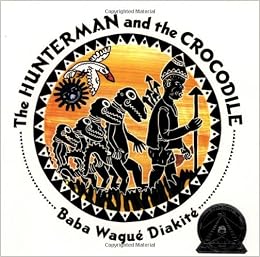
The Hunterman and the Crocodile

The Hunterman and the Crocodile: A West African Folktale
retold and illustrated by Baba Wagué Diakité
published by Scholastic Press 1997

Coretta Scott King Award

This folktale tells the story of three crocodiles who leave their home in the river and eventually become tired and famished. They meet a crocodile who they convince to take them back home to the river. They promise they won't eat him up as most crocodiles would do. However, when they return to the river, they question their choice and argue with right over wrong with the hunterman. Various animals weigh in on their opinions of the situation. The animals say that the crocodiles should eat the hunterman because of various things man does to the animals. At the end, a rabbit tells the man to bring the crocodiles back home to his family instead. Th man learns a valuable lesson, as his wife has fallen ill and needs the tears of a crocodile to live. The lesson to be learned is that man and nature must live in harmony.

I very much enjoyed this piece of literature. It would be a great mentor text for teaching write and wrong or respect for nature. The abstract illustrations really keep your intention. There is a mix of color and black and white along with watercolor backgrounds. It is a great book to show students the West African culture.

Diakité, B. W. (1997). The hunterman and the crocodile: A West African folktale. New York: Scholastic.

Tuesday, March 17, 2015

One Crazy Summer

One Crazy Summer
By Rita Williams-Garcia
Published by Amistad (2010)

Winner of the Coretta Scott King Award in 2011
Newberry Honor Book in 2011
(plus many many more!)

Our class read this award winning novel and created lesson plans based on the story. The moving story takes place during the civil rights movement in Oakland, California. Three young girls, Delphine, Vonetta, and Fern fly out to visit their long lost mother. With few memories of her, it leads to an adventurous and crazy summer involving the Black Panthers. I can see why this book won so many awards. Rita Williams-Garcia keeps you engaged and laughing even during heavy topics.

It is a great way for young readers to see the civil rights movement from a child's perspective. Not all students may be ready for the hot topic, but it is important for all students to learn about. The book would be a great class read to connect to social studies. Thanks to my wonderful classmates I have some great lesson ideas too!

Williams-Garcia, R. (2010). One crazy summer. New York: Amistad.

Monday, March 2, 2015

A Wreath for Emmett Till

A Wreath for Emmett Till by Marilyn Nelson
Illustrated by Philippe Lardy
Published by Houghton Mifflin Company 2005

Coretta Scott King Honor Award
Michael L. Printz Award for Excellence in Young Adult Literature from the American Library Association

This book takes on an important issue of the civil rights movement: Emmett Till and his lynching. I feel the author's explanation of her purpose for wiring this story into poetry is best explained through her own words. Regarding the writing of the poem she says, "I was nine years old when Emmett Till was lynched in 1955. His name and history have been a part of most of my life. When I decided to write a poem about lynching for young people, I knew I would write about Emmett Till. he was lynched when he was the age of the young people who might read my poem. After revisiting what I knew about lynching, reading more about it, and growing increasingly depressed, I also knew that I would write this poem as a heroic crown of sonnets. A sonnet is a fourteen- line rhyming poem in iambic pentameter. The rhyme scheme I chose to use in these sonnets is called Italian, or Petrarchan. A crown of sonnets is a sequence of interlinked sonnets in which the last line of one becomes the first line, sometimes slightly altered, of the next. A heroic crown of sonnets is a sequence of fifteen interlinked sonnets, in which the last one is made up of the first lines of the preceding poem".

This novel was difficult to read, but it gave a new perspective on an important issue of America's history. It would be a great mentor text or contributing text for a study on the civil rights for older students. The novel contains abstract imagery with colors that set the mood for each of the sonnets. At the end, an acrostic poem is formed, showing another type of poetry that students can utilize. It also provides notes on each of the sonnets she references in her poetry along with a brief story of Emmett Till.

I found a great online resource for using this piece of poetry in the classroom!

This piece of literature shows that poetry has the power to express even the darkest of things in a new light.

Nelson, M., & Lardy, P. (2005). A wreath for Emmett Till. Boston: Houghton Mifflin.

Thursday, February 19, 2015

Bud, Not Buddy

Bud, Not Buddy by Christopher Paul Curtis
Published by Delacorte Press 1999

Newberry Honor Book
Coretta Scott King Honor Book
ALA Notable Book
ALA Best Book for Young People
A Horn Book Fanfare
A Bulletin Blue Ribbon Book
A New York Times Book Review Best Book
A Publishers Weekly Best Book

With all these awards, you can see Bud, Not Buddy is a must read book. It was a book I could easily relate to because I grew up and still live in Michigan. It tells the story of ten year old Bud, a motherless boy, during the Great Depression. He runs away in search of his father with a suitcase of important things, and a flyer that he believes will lead him to his father. The book follows Bud's adventure to find his father.

Bud, Not Buddy would be a great book to read when learning about the Great Depression and all that is associated with that era such as jazz music.

This blog has some great project ideas related to the book!

Curtis, C. P. (1999). Bud, not Buddy. New York: Delacorte Press.

Monday, January 26, 2015

The Bat Boy & His Violin

The Bat Boy & His Violin by Gavin Curtis
Illustrated by E.B. Lewis
Published by Simon & Shuster (1998)
Coretta Scott King Award

The Bat Boy & His Violin takes place around the 1920s and 1930s during the time of the Negro National Baseball Leagues. Reginald, a young boy is a gifted violinist. He spends all his free time practicing in the house. His father is manager of the Dukes, the worst Negro team in the league. They need a bat boy, so his father selects Reginald to come be the bat boy of the Dukes. Reginald is not thrilled with the decision because he doesn't think he will have enough time to practice his violin. He begins as a bat boy and struggles at his duties. His father tells him to take a break and play his violin. As he plays his violin, the Dukes start to play better and end up winning their game. The Dukes credit their victory to Reginald and his violin. When they play their final game of the season against the best team of the league, they narrowly lose and Reginald feels bad he couldn't help them win. His father reassures him that his violin playing was a huge part of their success. He finally gets to perform in from of the team, family, and friends at his home; it was a recital to remember for Reginald.

While the story is fiction, it takes place in the historical framework of segregation. It would fit well into a history unit about segregation and baseball at that time in American history. It would give students a good view into the life of some people during that time. It also has a large music theme. Students who play the violin could easily understand Reginald's position. It could be a supporting book to a unit on Bud, Not Buddy also due to its music theme and historical placement.

The detailed water-color illustrations catch your eye. E.B. Lewis researched the time period in order to make his paintings most realistic. The language is a bit difficult for young readers.

The Coretta Scott King Award alone shows that this book represents the ideals of peace, non-violent social change, and brotherhood. This is a positive book to connect to our nation's past.

Curtis, G., & Lewis, E. B. (1998). The bat boy & his violin. New York: Simon & Schuster Books for Young Readers.